Ask a Palm Coast home inspector what they check first on a resale, and the answer usually isn't the roof or the HVAC unit. It's the address. Specifically, the letter.
Palm Coast was platted by ITT Community Development starting in the late 1960s into a grid of lettered sections, each one built with street names that share the section's initial. That naming convention wasn't just a developer's filing system. It also split the city into two very different inspection profiles that still hold today. Buy in the C or F Section and the inspector heads for the water's edge to look at the seawall. Buy inland and the inspection turns toward the septic tank and the drainage swale instead. The letter on the plat map tells you which conversation you're about to have before anyone sets foot on the property.
That distinction matters more this year than it has in the past, because Palm Coast's own capital projects office just confirmed something canal-front buyers need to hear before they write an offer: when a private seawall fails, the city is not the backstop.
What C and F Sections Put on the Inspection Report
The C and F Sections sit on Palm Coast's saltwater canal system with direct Intracoastal access, the setting behind much of the marketing imagery for waterfront living here. That access comes with a structural obligation. Every lot on those canals is separated from the water by a seawall, and on these lots the seawall gets what one Palm Coast inspection firm describes as a hard look during a sale, because it's frequently the most expensive single component on the property to repair and the one buyers are least likely to have evaluated themselves.
The failure signs are consistent across the industry: cracking or spalling at the cap, rust staining that signals corroding rebar, soil loss visible at the base on the water side, and small sinkholes forming in the yard behind the wall as fill migrates through gaps. None of that shows up in listing photos taken from the dock looking out. It shows up when someone walks the seawall at low tide and looks down instead of across the canal.
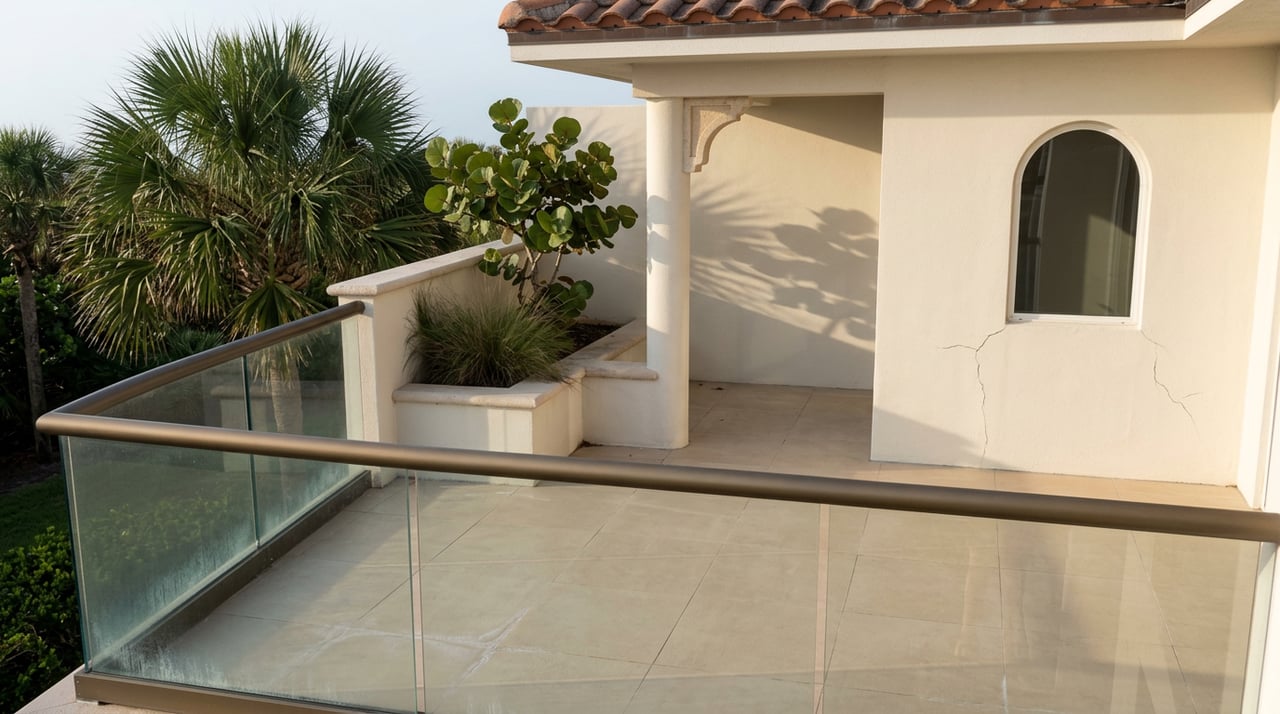
Salt exposure adds a second layer specific to these sections. Mechanical equipment near saltwater canals corrodes faster than the same equipment a few blocks inland, and lintel steel over windows and doors on block-and-stucco construction rust-jacks at a higher rate near the water, cracking the stucco around it from the inside out. An inspector working a C or F Section resale is checking for this pattern as a matter of routine, not because something looks obviously wrong.
What the Inland Sections Put There Instead
Move away from the canals and the inspection conversation changes completely. Outlying lots in Palm Coast's inland sections are more likely to run on well and septic rather than city water and sewer, and drainage swales on older lots have often gone unmaintained for years. Neither issue is dramatic on its own, but both are the kind of finding that surfaces late in a transaction if nobody asks about them early.
The larger pattern across both canal and inland sections is that Palm Coast's housing stock arrived in three distinct waves: the original ITT-era homes from the late 1970s and 1980s, a large second wave built between 1998 and 2007, and infill construction on remaining platted lots after 2015. Knowing which wave a specific house belongs to is often a better predictor of what an inspection will turn up than the square footage or the finish level, because it tells you where that house sits on the roof-replacement clock, the HVAC-replacement clock, and the panel-replacement clock all at once.
The Roof Question That Decides Insurability Everywhere
Regardless of section letter, one item drives whether a policy gets written at all in this market: roof age. Florida's wind mitigation form, OIR-B1-1802, is where insurance credits are won or lost, and it hinges on roof covering compliance with a documented permit date, the roof deck attachment method, the roof-to-wall connection, and the roof's shape. Original ITT-era homes are frequently on their first or second roof and past the twenty-year mark, which is exactly where insurance carriers start declining to renew.
Flagler County carriers commonly request a four-point inspection on older dwellings covering the roof, electrical, plumbing, and HVAC systems, and this is a routine request on resales throughout the lettered sections, not a red flag specific to any one property. HVAC systems past twenty years with degrading duct board plenums in the attic turn up often enough that it counts as expected rather than exceptional.
None of this is unique to any single listing. It's simply what buying in a market built in a compressed construction window looks like: an entire street can hit the same replacement point at roughly the same time, and insurers price for that pattern whether or not a given seller has addressed it yet.
The City Just Told You Who Pays for the Wall
Here is the piece of this that changed in 2026. Palm Coast's Phase III canal maintenance program began in January 2026 and, according to the city's own capital projects tracker, was about one percent complete as of late March, with the initial effort concentrated on seawall inspections across the canal system. The same update also records a funding determination that bears directly on canal-front sales: after review, the city concluded that Hazard Mitigation Grant Program funding does not apply to repairs on privately owned seawalls.
That finding closes a door some owners had been counting on. The city has maintained an internal task force, including its Code Enforcement Manager, Building Official, Stormwater Engineer, and Assistant City Manager alongside representatives from seawall companies, working to identify funding sources for the broader canal system. But the private seawall in front of an individual C or F Section home remains the homeowner's responsibility to fund, inspect, and maintain, with no federal disaster money standing behind it.
For a buyer, this is useful information rather than bad news. A seawall that hasn't been inspected in years isn't automatically a deal-breaker, but it is a cost center that belongs on the negotiating table rather than discovered after closing. Repair costs elsewhere along Florida's canal systems run from a few thousand dollars for cap repair and crack sealing up into the tens of thousands for a full replacement, depending mostly on the wall's linear footage and how far deterioration has progressed before anyone addresses it. Waiting rarely makes the number smaller.
Real estate transactions involving waterfront property with a seawall generally call for disclosure of known structural deficiencies, and it's increasingly common for buyers, their agents, and their lenders to request an engineer-sealed condition report before closing rather than relying on a visual walk of the property. Requesting that report as a contingency, rather than treating the seawall as a cosmetic feature of the lot, is the difference between negotiating from information and negotiating from hope.
Reading a Listing by Its Letter
Put together, the section letter functions as a quick filter for what a serious buyer should ask about before scheduling a showing, let alone writing an offer.
- C or F Section, canal-front: ask for seawall age, material, and any prior repair permits, and budget for an engineer-sealed inspection before the option period closes
- Inland lettered sections: confirm well versus city water, septic versus sewer, and the last time the drainage swale was cleared
- Any section, house built before roughly 2005: request the wind mitigation report and roof permit history before assuming a number for insurance
- Any canal-front listing: ask directly whether the seller has documentation of seawall maintenance, since the city's funding update means this cost isn't going anywhere
A listing price reflects the house and, in the C and F Sections, the lot's water access. It rarely reflects a full accounting of what stands between the yard and the canal. The buyers who ask about the wall before they fall in love with the view are the ones who negotiate from a position of knowing exactly what they're buying.
If you're weighing a specific address in Palm Coast and want a read on what its section letter, build year, and canal exposure actually mean for your inspection and insurance costs, Coastal Pros can walk through it with you. Schedule a private consultation before you write the offer, not after the inspection report comes back.